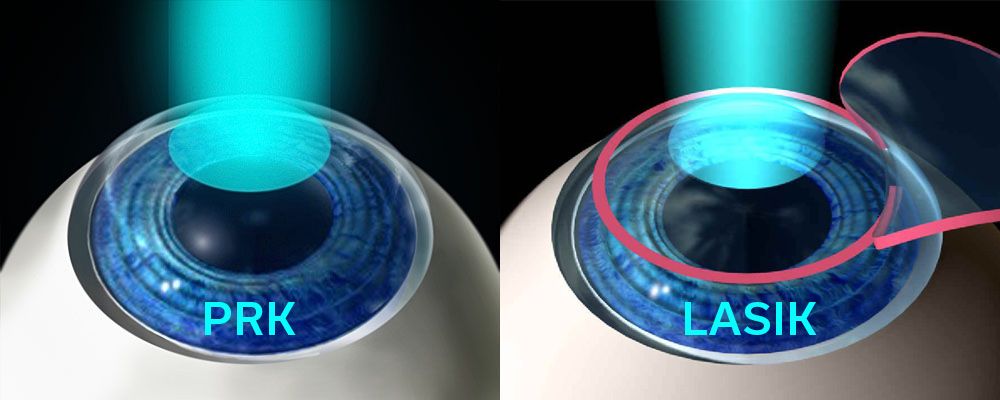
PRK is a proven, highly effective laser vision correction procedure that achieves the same exceptional results as LASIK, without the creation of a corneal flap, making it the preferred choice for patients who are not ideal LASIK candidates or who prefer a flapless approach.

What Is PRK?
Photorefractive keratectomy (PRK), also known as advanced surface ablation, is a laser vision correction procedure that uses an excimer laser to reshape the cornea and correct nearsightedness, farsightedness, and astigmatism. Unlike LASIK, which creates a thin corneal flap before applying the laser, PRK removes the outer epithelial layer of the cornea entirely to expose the stromal tissue beneath, applies the excimer laser to sculpt the cornea to the desired shape, and then allows the epithelium to regenerate naturally over the following days. A bandage contact lens is placed on the eye after surgery to protect the surface and improve comfort during healing for several days following the procedure.
Because no flap is created, PRK preserves more corneal tissue and eliminates all flap-related risks, at the cost of a longer recovery period compared to LASIK. The final visual outcomes achieved with PRK are equivalent to those of LASIK, and the same WaveLight EX500 excimer laser is used for both procedures at Princeton Eye Group.